How to learn with AI without getting dumber
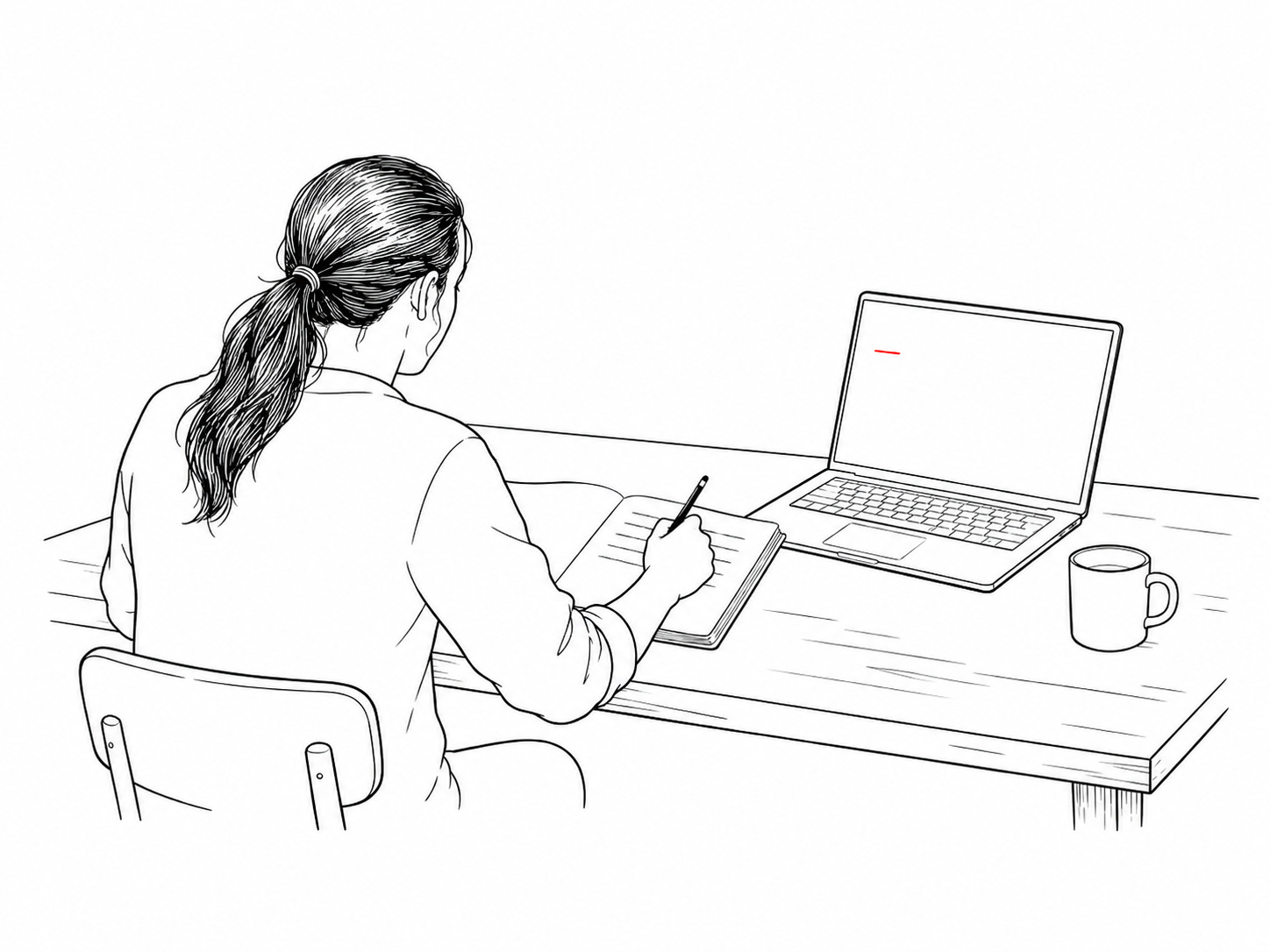
AI has made a lot of knowledge workers faster and a little worse at thinking alone. A first draft, a spreadsheet formula, or a meeting summary that used to take an hour now takes ten minutes. The tradeoff is practice: people are doing fewer hard reps. You can’t quite remember the last time you sat with a hard question for an hour. The blank page feels more unfamiliar than it used to. You send the plan after the model has cleaned it up, and when someone in the meeting asks about the second recommendation, you cannot quite explain why it’s there.
At the extreme, there are now public reports of agreeable chatbots feeding users’ delusions, and quieter cases of people asking the model for reality checks until the model becomes the reality check. Most office workers face a milder version: the model becomes the place they go first to think, and over a year they get worse at thinking on their own.
Nobody knows what AI looks like five years from now, so any career plan that depends on a precise AI forecast is weak. The safer plan is to get better at what you already do, learn three adjacent skills your job already exposes you to (finance, design, writing, automation, sales, whatever), and use AI as a tool instead of a crutch. A marketer who can write, read a P&L, sketch a landing page, and automate reports stays useful whether AI accelerates or stalls.
The four steps expose the moment where you stop thinking and ask the model to think for you. By the end you’ll have run them once on a skill you’ve been meaning to learn. Have a chat tab open as you read. Any of Claude, ChatGPT, or Gemini works. If you don’t have an account,DeepSeek Chat, Qwen Chat, Z.ai Chat, and Kimi Chat are free without signup.
Step 1. Pick one skill adjacent to your day job
Write down one skill or task you’ve been wanting to learn that sits next to your day job rather than inside it. Be specific about what “done” looks like.
Vague: learn finance. Specific: read my company’s last earnings release and explain three things in it to a friend without re-opening the document.
Vague: understand AI. Specific: read a popular article on how image generators work and explain it to a friend over coffee, in plain English.
Vague: get better at design. Specific: redesign one screen of an app I use every day, write down the reasons for each change, and show it to a working designer without flinching.
A good finish line is demonstrable, not conversational. If yours uses the word “understand,” rewrite it as a specific output or action.
Exercise 1 (2 min). Write your finish line on a sticky note. Make it specific enough that a friend watching could confirm: yes, you did it.
Step 2. Make the model interview you until you stumble
You cannot list your blind spots by staring at a blank page. Turn the model into an interviewer instead. The questions you stumble on are the gaps you could not spot alone.
Exercise 2 (5 min). Paste this into your chat. Replace the curly braces.
`You are interviewing me to find gaps in my knowledge of {your topic}.
I'm trying to be able to {your finish line from exercise 1}.
What I think I already know: {two or three sentences on your current level}.

Ask me one question at a time. Make each one harder than the last.
When I get something wrong or hesitate, follow up to find out how deep
the gap goes. Don't teach me yet, just diagnose. Stop when I get three
questions in a row clean, or after fifteen minutes.`
You will know within the first answer or two whether the model is following the assignment. If the questions arrive one at a time, get incrementally harder, and follow up when you stumble, keep going. If the model lectures, asks softballs, or summarizes your topic back at you, paste: “Stop teaching me. Just ask the next question and make it harder than the last one.”
Push back when the model gets too polite. After three or four questions, paste: “You’re being too easy on me. The point is to find what I don’t know. Be tougher.” That instruction often matters more than the original prompt, because most chatbots default to encouragement.
When you’re done, keep every question that made you hesitate. That list is your study plan. It is a better first plan than a generic course outline, because it starts from the gaps you actually have instead of the ones a textbook author predicted you would have.

Step 3. Try first
This is the step most people skip, and the method falls apart when they do. If you ask the model for the answer before you have sat with the question yourself, the model decides what the problem is before you do, and you never find out what you would have thought. The cleanest measure of the gap is the distance between your first attempt and a competent one.
Trying first feels slow, but the useful questions usually appear during the slow minutes. Twenty minutes spent staring at a blank page, writing a sentence, deleting it, writing another, deleting that one too. Those are the minutes when the useful questions start to appear. Skip the twenty minutes and you skip the part where the learning happens.
Exercise 3 (5 min). Pick the smallest item from your gap list. Set a timer. Close the chat tab. Write the answer cold — three sentences, three bullet points, a rough sketch, a list of numbers. For this workshop, five minutes is enough. In real life, the cold work takes fifteen to thirty.
A confused first attempt gives the model something concrete to diagnose. If yours came out clean, you picked a question you already knew. Pick a harder one next round.

Step 4. Grade second
Paste your attempt with a rubric, and tell the model not to encourage you. A rubric is a short list of what “good” looks like in plain criteria. Three bullets are usually enough. Without one, the model says “Great start,” gives a few minor suggestions, and your bad draft never gets called out.
Exercise 4 (3 min). Paste this.
`Here is my attempt at {what you were trying to do}: {paste your attempt}.

Grade it against this rubric:
- {criterion 1, e.g. "names a specific number, not a range"}
- {criterion 2, e.g. "no claim made without evidence"}
- {criterion 3, e.g. "could be read in 90 seconds"}

Don't be encouraging. Be useful. Find the weakest part.
Tell me the single most important problem to fix first, and why.`
A useful response names the most important problem first, in specific language, with a fix attached. “The second paragraph claims X without evidence — either drop it or add the source” is the kind of feedback you want. By contrast, “Great start! Consider adding more detail to paragraph two” tells you nothing, which means the model did not take the be-blunt instruction. Re-run with: “That was too soft. What is actually wrong here? Be blunt.”
Read what comes back slowly, and don’t fix anything yet. Add each item the model caught to your gap list. Only after the list is updated, decide whether to repair this draft or start over. Starting over is often faster than patching, especially early on.
Tomorrow’s practice comes from the first item on that feedback list.
Using AI on real work
The four steps are for dedicated study time. Once that loop is running, the open question is how much of it to use on the rest of your day.
Match effort to cost. Send the quick Slack message. For a contract, a public post, or code that ships, run the four steps and ask a second chatbot to find what the first one missed. If you put the same effort into everything, the important work comes out tired by the time you reach it.
Plan before you act on anything complicated. A fresh chat does not know your situation. Ask the model to draft a plan first, push back on the weak parts, then let it execute the parts you still endorse. When the chat starts repeating itself or forgetting what you said earlier, get a handoff note and start a new chat:
`Write a handoff note for a new chat. Include what we're trying to
accomplish, what we've tried, what's worked, what hasn't, where we
are right now, and the next step. Keep it tight.`
Cross-check what matters. When an answer is important, paste it into a different chatbot and ask where the first one was wrong. If two models give you the same answer, that is weak evidence; they can share an error. If they give you different answers, you have found a question that needs more investigation than either chatbot is giving it.
Two prompts worth keeping in a notes file. Use them on any answer you would act on:
Argue against your own answer. “Make the strongest case against what you just told me. Tell me which parts of your original answer you would weaken in light of it.” A weak counter-argument means the original was probably weak too.
Ask for sources, then check them. “Give me a verifiable source for that, with publication name and year. If you cannot find one, say so.” Then spend thirty seconds confirming the source exists. Models invent citations that read as real until you search for the paper and it isn’t there.
Don’t send first drafts. That includes the polite Slack message you typed in thirty seconds and almost sent without reading. The first draft is where you find out what you mean. What other people read should be at least a second draft.
Before sending anything public, search the draft for these common AI tells: “it’s not just,” “navigate the,” “in today’s landscape,” “delve into,” “tapestry,” “harness,” “at its core,” “in essence.” Then search for your own filler, the soft phrases you reach for when you have not decided what you mean. Mine, in this article: “the move,” “the version,” “the way,” “thing,” “the bet,” and most uses of “real.” Most got cut. The ones that survived I could defend. This article went through eight rewrites before it stopped failing this check.
Tomorrow morning: take the top item from your grader. Twenty minutes writing cold. Three minutes asking the model to grade it. The day after, the next item. After a few weeks of this, you will be in a meeting and someone will ask a question you would have shrugged at a month ago. You will answer it without trying. Then go home and write the next twenty-minute cold piece on whatever you couldn’t quite answer.
Take the prompts with you. All five prompts from this article, ready to paste into any chat: bit.ly/3RZIDTu
Jeff Kazzee writes about AI, careers, and learning to think clearly. Subscribe on Substack for the next workshop. Find him on X, LinkedIn, and GitHub.